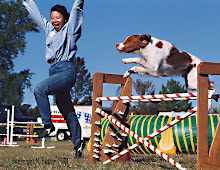
In a past post, I discussed coprophagia in dogs.
Dr. Ben Hart, a board-certified veterinary behaviorist from UC Davis, did a study using internet surveys regarding this subject, and the results and conclusions were presented at the AVSAB annual meeting in 2012. He learned that as many as 16% of dogs ate stools frequently. 85% of these dogs at the feces of other dogs. Intact males were less likely to eat feces than neutered males or females (spayed or not). Diet did not influence this habit, so dogs are not likely to be eating feces to gain something that they are lacking nutritionally. 40% of Border Collies and Shetland Sheepdogs ate feces; no Poodles were reported to do so. Interestingly, 90% of the stools were eaten within 2 days of deposition.
Dr. Hart's conclusion from this study was that since dogs eat the stools of other dogs while they were relatively fresh, that coprophagia may have been a selected-for behavior because it provides a way to keep the den clean and protect puppies from intestinal parasites, which would not yet have matured to be at an infective stage.
Dr. Hart's study also found that deterrents (such as For-Bid, Deter-um, etc.) and food additives (pineapple, meat tenderizer) were effective only 0-2% of the time to prevent coprophagia. Neither punishment (yelling, electronic collars) nor reward based traning methods (clicker traning) were effective. The best solution was to pick up the dog promptly after it is deposited... or, perhaps, as Dr. Hart jokes, get an intact, male Poodle.
Friday, September 13, 2013
Thursday, September 5, 2013
Ideas for Post-Surgical Exercise Restriction
Dogs who have undergone surgery are often hard to keep quiet post-operatively. The same is true for dogs who have suffered an injury and need to be exercise-restricted.
The importance of rest during the healing period cannot be overstated; normal activity can lead to painful hematomas, seromas, malalignment of a fracture, exacerbation of or failure to heal from a soft tissue injury or worse. How can an owner make their active dog rest?
The importance of rest during the healing period cannot be overstated; normal activity can lead to painful hematomas, seromas, malalignment of a fracture, exacerbation of or failure to heal from a soft tissue injury or worse. How can an owner make their active dog rest?
- Consult with your veterinarian or rehabilitation specialist for the details regarding just how much activity is allowable given your pet's individual case. Does the dog have to be confined to a cage? Are leash walks allowed, and if so, what length leash, how far, how long, how often, and are hills ok? Is the dog allowed out in the yard with the other dogs? Is the dog allowed to be loose in the house, with or without the other dogs?
- Engage the mind. Play the brain games (Find It!, Shell Game) described in my last post on Cognitive Dysfunction: Behavior Modification. There are some commercially available dog games that are puzzles in which food is hidden. Practice sit-stays and down-stays. Teach your dog to balance something on his body, i.e., a toy on his nose, a treat on his paw. I taught my first dog, Marcus (seen with me in my profile picture) to start the balancing tricks with a 12-inch length of grosgrain ribbon (it did make a neat Christmas picture, as the ribbon was red). Note: please do keep the treats relatively small in size. If your dog is being exercise-restricted, he is not burning as many calories as normal. Let's not contribute to an obesity problem.
- Consider offering a stuffed Kong toy once or twice daily. You can plug the small end with peanut butter, stuff it with regular kibble or other goodies, pour in some dilute low-sodium broth, place upside down in a plastic up and freeze it. Kong also makes stuffing that can be squirted into a Kong or similar food-dispensing toy. Other alternatives for stuffing include squeeze cheese, cheese melted for a few seconds in the microwave and cooled, and small amounts of peanut butter.
- Chewing is a great way for dogs to burn energy. If your dog has not suffered through gastrointestinal surgery, consider offering something to chew. There are some toys that can be refilled, and if your dog can tolerate it, consider rawhide, bully sticks or pig ears (please supervise when these are given to make sure big pieces that could potentially cause an obstruction are not swallowed).
- If your dog is allowed to take walks, consider using a Gentle Leader headcollar. This will give you much better control over the pace at which your dog will walk. Please refer to prior post on the Gentle Leader.
- If your dog is inherently active, and you feel that you will need help taking the edge off a normally frenetic attitude, please discuss with your veterinarian the possible use of low-level oral sedatives.


Thursday, August 29, 2013
Cognitive Dysfunction, Part III: Behavior Modification
In Parts I and II of this series, we have discussed what Cognitive Dysfunction Syndrome (CDS) is, and what medical treatments are available for it. In this section, we will discuss what an owner can do at home, through behavior modification, to help maintain his senior dog's aging brain.
One of the symptoms of CDS is alterations to the dog's sleep/wake cycle. Many of these dogs sleep all day and pace around the house all night, keeping owners awake. Attempts should be made to keep these dogs active and awake during the day. Take the pet for a walk, play games outside or inside the house. If the dog is active during the day, then hopefully he will be more tired and apt to sleep when the owner chooses to, also.
Another symptom of CDS is house soiling in a previously well-trained dog. Try to get the dog outside to eliminate on a very regular and perhaps more frequent schedule. Some of these older dogs forget what they went outside for, so taking them to a special toileting area can help them to remember their "duty."
It is well-discussed how protective "brain games" can be for human minds in protecting them against dementia. There are also "brain games" you can play with your dog (and it can be fun, even in a young dog!). These activities increase blood flow to the brain, which can be protective, even in a dog who does not exhibit signs of CDS.
One of the symptoms of CDS is alterations to the dog's sleep/wake cycle. Many of these dogs sleep all day and pace around the house all night, keeping owners awake. Attempts should be made to keep these dogs active and awake during the day. Take the pet for a walk, play games outside or inside the house. If the dog is active during the day, then hopefully he will be more tired and apt to sleep when the owner chooses to, also.
Another symptom of CDS is house soiling in a previously well-trained dog. Try to get the dog outside to eliminate on a very regular and perhaps more frequent schedule. Some of these older dogs forget what they went outside for, so taking them to a special toileting area can help them to remember their "duty."
It is well-discussed how protective "brain games" can be for human minds in protecting them against dementia. There are also "brain games" you can play with your dog (and it can be fun, even in a young dog!). These activities increase blood flow to the brain, which can be protective, even in a dog who does not exhibit signs of CDS.
- Find It! Have a family member or friend hold your dog in a room while you go into another room to hide a treat or favorite toy. Return to your dog, and tell him to find the treat. Start easy, and as your dog gets the gist of the game, make it more challenging.
- The Shell Game. Turn 3 cups upside down and place a piece of kibble or treat under one of them. Shuffle the cups around and have your dog "pick" one of the cups. If he selects the correct cup, then he gets the treat!
- New tricks. Teach your old dog a new trick. While there are many methods for trick training, clicker training is a method that is positive, hands-off, and stimulates the dog to think. Tricks for older dogs include: Walk backwards, speak, hand touch, touch a target, such as a plastic lid, circle right, circle left, play dead, shake hands, wave. The possibilities are endless!
- Take your dog for a walk. Walking off your property can be more than just exercise for the body, it is very stimulating for the brain. When a dog sniffs, he is reading the scent paths of all those who have gone before him - people, other dogs, cats, and wildlife.
Cognitive Dysfunction Syndrome, Part II: Treatment
There are multiple medical treatments that can help to alleviate, or at least slow to progression of signs Cognitive Dysfunction Syndrome (CDS).
Anipryl (selegiline hydrochloride) is the first and only drug approved by the FDA to control the clinical signs of CDS. Anipryl is a monoamine oxidase inhibitor that will help to decrease the breakdown of dopamine in the brain, not only making dopamine more available, but also reducing the dangerous, cell-killing free radicals that are produced during dopamine metabolism. Anipryl should not be used concurrently with tricyclic antidepressants (i.e., amitriptyline, clomipramine) or selective serotonin reuptake inhibitors (i.e., fluoxetine). Use with any product containing Amitraz (i.e., Preventic collar, Mitaban dip, Certifect) is also not recommended.
Hill's b/d diet contains antioxidants and omega-3 fatty acids to help protect brain cells from the dangerous free radicals that are generated by the breakdown of dopamine by monoamine oxidase B (MAOB).
S-AdenosylMethionine (SAMe) is a molecule naturally present in the body that is well documented for its effects on membrane fluidity, antioxidant cellular activity and the renewal of certain neurotransmitters in the central nervous system. This molecule is available in a neutraceutical form called Novifit. This form of SAMe is a specific salt that can penetrate the blood-brain barrier for increased efficacy in the brain.
Senilife is another nutritional supplement that is a proprietary mixture containing phosphatidylserine, pyridoxine, Ginkgo Biloba, resveratrol and vitamin E that can help to prevent cognitive decline.
neutricks is a new supplement that is supported by evidence-based research for healthy brain aging. This supplement contains apoaequorin, a jellyfish calcium-binding protein. This supplement was shown to improve learning, accuracy, and enhance attention.
These medical treatment options can be used singly or in combination. Please consult with your veterinarian what might be best for your dog if you suspect your dog has CDS.
Coming up next.. Part III: Behavior modification
Anipryl (selegiline hydrochloride) is the first and only drug approved by the FDA to control the clinical signs of CDS. Anipryl is a monoamine oxidase inhibitor that will help to decrease the breakdown of dopamine in the brain, not only making dopamine more available, but also reducing the dangerous, cell-killing free radicals that are produced during dopamine metabolism. Anipryl should not be used concurrently with tricyclic antidepressants (i.e., amitriptyline, clomipramine) or selective serotonin reuptake inhibitors (i.e., fluoxetine). Use with any product containing Amitraz (i.e., Preventic collar, Mitaban dip, Certifect) is also not recommended.
Hill's b/d diet contains antioxidants and omega-3 fatty acids to help protect brain cells from the dangerous free radicals that are generated by the breakdown of dopamine by monoamine oxidase B (MAOB).
S-AdenosylMethionine (SAMe) is a molecule naturally present in the body that is well documented for its effects on membrane fluidity, antioxidant cellular activity and the renewal of certain neurotransmitters in the central nervous system. This molecule is available in a neutraceutical form called Novifit. This form of SAMe is a specific salt that can penetrate the blood-brain barrier for increased efficacy in the brain.
Senilife is another nutritional supplement that is a proprietary mixture containing phosphatidylserine, pyridoxine, Ginkgo Biloba, resveratrol and vitamin E that can help to prevent cognitive decline.
neutricks is a new supplement that is supported by evidence-based research for healthy brain aging. This supplement contains apoaequorin, a jellyfish calcium-binding protein. This supplement was shown to improve learning, accuracy, and enhance attention.
These medical treatment options can be used singly or in combination. Please consult with your veterinarian what might be best for your dog if you suspect your dog has CDS.
Coming up next.. Part III: Behavior modification
Cognitive Dysfunction Syndrome, Part I: What is it?
Our geriatric dogs often suffer from a variety of physical ailments. If we are blessed enough to have our dogs live to an advanced age, they do inevitably become arthritic and lumpy, and some become affected by other chronic medical problems. Some older dogs also experience behavior changes unrelated to anything that can be found through physical testing.
Cognitive Dysfunction Syndrome (CDS) is a form of dementia in older dogs. Some of the clinical symptoms include:
Many of these clinical signs appear very gradually - so much so that the owner is often unaware of the early subtle changes in behavior.
What causes CDS? Beta-amyloid is a protein toxic to neurons that accumulates in the aging brain; it may form plaques. This is similar to findings in the brains of human Alzheimer's patients. The exact role of beta amyloid accumulation in the development of cognitive dysfunction is not yet known, but its accumulation seems to lead to decreased neuronal function in the brain.(1)
Neurotransmitters are also altered during aging. Monoamine oxidase B (MAOB) is an enzyme that has been found to have increased activity in older dogs (2). In dogs with CDS, the increase is even greater than what is considered for a normal aging change. MAOB breaks down dopamine, a neurotransmitter. In humans, dopamine affects brain processes that control movement, emotional response, and ability to experience pleasure and pain. Also, metabolic processing of dopamine results in release of cell-killing free radicals.
A study at the University of California-Davis found that 62% of 11- to 16-year-old dogs showed signs in at least one category of CDS (3, 4).
CDS can make a dog's life lonely, separated from family members who cherish their older dog's companionship. It can be as hard on family members as it is on the dog.
Coming up next.. Part II: Treatment
References:
1. Cummings BJ, Head E, Afagh AJ, Milgram NW, Cotman CW: Beta-amyloid accumulation correlates with cognitive dysfunction in the aged canine. Neurobiol Learning & Memory 1996 Vol 66 (1) pp. 11-23.
2. Campbell S, Trettien A, Kozan B: A noncomparative open-label study evaluating the effect of selegiline hydrochloride in a clinical setting. Vet Ther 2001 Vol 2 (1) pp. 24-39.
3. Neilson JC, Hart BL, Ruehl WW: Cited in Hart BL, Hart LA: Selecting, raising and caring for dogs to avoid problem aggression. JAVMA, 210(8):1129-1134; 1997.
4. Ruehl WW, Hart BL: Canine Cognitive Dysfunction. In Psychopharmacology of Animal Behavior Disorders (Dodman NH, Schuster L, eds.). Boston: Blackwell Scientific, 1998; pp. 283-304.
Cognitive Dysfunction Syndrome (CDS) is a form of dementia in older dogs. Some of the clinical symptoms include:
- Disorientation: Wanders aimlessly, gets lost in a familiar house or yard, gets "stuck" in corners or under/behind furniture, stares into space, stands at the hinge side of the door to be let out, does not recognize familiar people, does not respond to his name, forgets why he went outside.
- Decreased interaction with family members: Seeks less attention, walks away while being petted, less enthusiasm upon greeting, or fails to greet family members at all.
- Altered activity and sleep patterns: Flipping of day/night activity/sleep cycles, increased wandering/pacing, vocalization (particularly at night) for no reason.
- Lapse in housetraining: Urinates indoors, has accidents inside soon after being outside, does not ask to go outside.
Many of these clinical signs appear very gradually - so much so that the owner is often unaware of the early subtle changes in behavior.
What causes CDS? Beta-amyloid is a protein toxic to neurons that accumulates in the aging brain; it may form plaques. This is similar to findings in the brains of human Alzheimer's patients. The exact role of beta amyloid accumulation in the development of cognitive dysfunction is not yet known, but its accumulation seems to lead to decreased neuronal function in the brain.(1)
Neurotransmitters are also altered during aging. Monoamine oxidase B (MAOB) is an enzyme that has been found to have increased activity in older dogs (2). In dogs with CDS, the increase is even greater than what is considered for a normal aging change. MAOB breaks down dopamine, a neurotransmitter. In humans, dopamine affects brain processes that control movement, emotional response, and ability to experience pleasure and pain. Also, metabolic processing of dopamine results in release of cell-killing free radicals.
A study at the University of California-Davis found that 62% of 11- to 16-year-old dogs showed signs in at least one category of CDS (3, 4).
CDS can make a dog's life lonely, separated from family members who cherish their older dog's companionship. It can be as hard on family members as it is on the dog.
Coming up next.. Part II: Treatment
References:
1. Cummings BJ, Head E, Afagh AJ, Milgram NW, Cotman CW: Beta-amyloid accumulation correlates with cognitive dysfunction in the aged canine. Neurobiol Learning & Memory 1996 Vol 66 (1) pp. 11-23.
2. Campbell S, Trettien A, Kozan B: A noncomparative open-label study evaluating the effect of selegiline hydrochloride in a clinical setting. Vet Ther 2001 Vol 2 (1) pp. 24-39.
3. Neilson JC, Hart BL, Ruehl WW: Cited in Hart BL, Hart LA: Selecting, raising and caring for dogs to avoid problem aggression. JAVMA, 210(8):1129-1134; 1997.
4. Ruehl WW, Hart BL: Canine Cognitive Dysfunction. In Psychopharmacology of Animal Behavior Disorders (Dodman NH, Schuster L, eds.). Boston: Blackwell Scientific, 1998; pp. 283-304.
Monday, March 7, 2011
New toy review: FroliCat
I was in a pet store this weekend and came across a toy new to me. It is called FroliCat Bolt, and it is a device you can place on the floor or any other stable surface, or hold in your hand, and it will emit a low-power laser beam and move it in random patterns for your cat to chase. It also has a timer so that the device will automatically turn off after 15 minutes. It requires four AA batteries. What a great way to exercise/entertain the cat for the busy cat owner!

There is a similar product called FroliCat Dart that has variable speed and timer settings. The Dart is also marketed as a RouseDog Product. WARNING! Do NOT use these types of devices on dogs! You can create a case of obsessive-compulsive disorder (OCD) in your dog by encouraging them to chase lights and shadows (and some dogs do not need much encouragement).

There is a similar product called FroliCat Dart that has variable speed and timer settings. The Dart is also marketed as a RouseDog Product. WARNING! Do NOT use these types of devices on dogs! You can create a case of obsessive-compulsive disorder (OCD) in your dog by encouraging them to chase lights and shadows (and some dogs do not need much encouragement).
Tuesday, February 8, 2011
Feline Redirected aggression
The scene: The three-season room at the rear of Mrs. Zee's house
The action: Mrs. Zee is reading the newspaper on the chaise lounge. Ay the cat is sunning on a window sill with a stunning view of the garden. He grooms himself languidly while pausing occasionally to watch a bird or butterfly flit by. Ay shares his window sill with Bee, a fellow feline housemate, who is dozing while basking in the warmth of the sun. Suddenly, See, the new neighbor's Siamese cat saunters through the garden. Ay hisses and growls, and his coat puffs up, but there is no response from See, who cannot see or hear the cat behind the window. Ay then attacks Bee, jumps on his back and bites him. Bee, not knowing what happened, runs away, completely bewildered and injured. Mrs. Zee, also bewildered and quite angry at Ay, throws her paper in Ay's direction and hurries to find out the extent of Bee's injuries.
The analysis: Redirected aggression is a phenomenon in which the recipient of the aggression is not the stimulus for the aggression, and is often an innocent bystander. This type of aggression can occur in both dogs and cats, but I tend to see it more frequently in cats. The victims of this form of aggression can include other cats, dogs, or people. The owners of these cats often express surprise at the sudden violence that can erupt between parties that previously shared a friendly relationship. Owners may or may not know what the stimulus of the aggression was; often the location of the incident provides clues to this.
The solution to this type of problem is to identify and manage the source of the aggression. This can be especially tricky in cats because the early signs of aggression can be so subtle. In Mrs. Zee's case, she would either need to keep neighboring cats out of her garden (www.cat-repellant.info), keep Ay out of the room where he can look out the window, or she would need to block her cat's view of the garden through which cats can stray. Obstructing the cats' view can be acheived through curtains, blinds, or translucent contact paper on the lower half of the window.
Also a word of caution: owners should not use their hands (or other body parts) to physically separate fighting pets. Throw a blanket over them, douse them in large volumes of water, sound an air horn, use a broom to physically separate them. A 2006 study published in the Journal of Hand Surgery revealed that stray animals do not contribute the majority of bites to the hand. Two-thirds of the patients in this study required hospitalization for at least intravenous antibiotics.
The action: Mrs. Zee is reading the newspaper on the chaise lounge. Ay the cat is sunning on a window sill with a stunning view of the garden. He grooms himself languidly while pausing occasionally to watch a bird or butterfly flit by. Ay shares his window sill with Bee, a fellow feline housemate, who is dozing while basking in the warmth of the sun. Suddenly, See, the new neighbor's Siamese cat saunters through the garden. Ay hisses and growls, and his coat puffs up, but there is no response from See, who cannot see or hear the cat behind the window. Ay then attacks Bee, jumps on his back and bites him. Bee, not knowing what happened, runs away, completely bewildered and injured. Mrs. Zee, also bewildered and quite angry at Ay, throws her paper in Ay's direction and hurries to find out the extent of Bee's injuries.
The analysis: Redirected aggression is a phenomenon in which the recipient of the aggression is not the stimulus for the aggression, and is often an innocent bystander. This type of aggression can occur in both dogs and cats, but I tend to see it more frequently in cats. The victims of this form of aggression can include other cats, dogs, or people. The owners of these cats often express surprise at the sudden violence that can erupt between parties that previously shared a friendly relationship. Owners may or may not know what the stimulus of the aggression was; often the location of the incident provides clues to this.
The solution to this type of problem is to identify and manage the source of the aggression. This can be especially tricky in cats because the early signs of aggression can be so subtle. In Mrs. Zee's case, she would either need to keep neighboring cats out of her garden (www.cat-repellant.info), keep Ay out of the room where he can look out the window, or she would need to block her cat's view of the garden through which cats can stray. Obstructing the cats' view can be acheived through curtains, blinds, or translucent contact paper on the lower half of the window.
Also a word of caution: owners should not use their hands (or other body parts) to physically separate fighting pets. Throw a blanket over them, douse them in large volumes of water, sound an air horn, use a broom to physically separate them. A 2006 study published in the Journal of Hand Surgery revealed that stray animals do not contribute the majority of bites to the hand. Two-thirds of the patients in this study required hospitalization for at least intravenous antibiotics.
Thursday, January 27, 2011
Attention-Seeking Behavior
Dogs are very social creatures, and they often crave attention from their humans. Cats can also be very attached to their people. Attention seeking behaviors can range from sitting next to, and staring at the human of interest, to touching, licking, jumping, vocalizing, scratching, biting, humping and stealing to demand attention.
This is a mild behavior problem that can be extremely annoying for owners and their friends. Often the barrier to fixing this problem is not the pet, but the owners who inadvertantly reward the attention-seeking behavior. It is important to realize that attention comes in multiple forms, including touching, speaking to, or even looking at the pet. Some pets also do not recognize the difference between positive attention (petting, cooing) and negative attention (punishment); attention is attention!
The obvious solution to the problem of attention-seeking behavior is to (1) teach the pet when and how it is appropriate to solicit attention, and (2) remove all attention from the pet when he actively solicits it otherwise.
It may help to have scheduled interactions with the pet. Keeping activities such as playing, brushing, and teaching tricks on a regular, predictable schedule can help the pet, particularly if he is anxious. I recommend 15 minutes in the morning and 15 minutes in the evening for the quality interaction.
Also employing the "Nothing in Life is Free" philosophy (see post on this blog from June 2009) can help to set up a way for the dog to ask for attention in a manner that is not obnoxious, or that feeds into his anxiety.
What should be done if the pet acts in an unacceptable manner to solicit attention? Below is a list of common behaviors and solutions:
1. Touching, head on lap or foot, leaning against the leg; also licking - Remove your body part from the pet. If the pet persists, get up and leave the room.
2. Jumping, jumping onto your lap - Silently turn away from the dog and allow the dog's paws to slough off your body. If you are seated, slowly rise without touching the dog and allow the dog to slide off your lap. If the dog persists and tries to jump on your back, walk away, and put a door between you and the dog. Do not push the dog off you or knee the dog, for that provides negative attention (and remember, negative attention is still attention!).
3. Vocalizing (this can run the gamut from whining to vociferous barking and screaming) - Ignore the dog. Put in ear plugs, listen to an MP3 player through ear phones. If not ignored, this particular behavior has great potential to escalate.
4. Humping (owner, other pets, or inanimate objects) - Ignore the dog unless the victim is in danger. If the pet is humping your leg, remove your body part and walk away without saying a word.
5. Stealing (shoes, remote controls, children's toys, etc.) - Ignore the dog unless he is in danger. When the dog seems to lose interest, call the dog to you, make him sit (Nothing in life is free!), then reward him for the sit. Then, isolate the dog and retrieve the stolen item.
6. Scratching, biting - When the pet does bodily harm in the attempt to demand attention, try to keep any limbs in close to the body so there is as little as possible to "grab". You may need to use an aversive to prevent the harmful behavior. The aversive would in response to behavior that precedes the bodily contact, including stalking, eye contact, and sometimes even approach. Aversives include sounding an air horn, using a battery-powered water gun, using a citronella-scented compressed air canister (Spray Shield). If the people in the household need to be reminded to be vigilant about the pet's behavior, consider having the pet wear a bell attached to the collar.
It is easier to list what one should NOT do, it is harder for most owners to remember what they SHOULD do. If your pet approaches you and sits, pay attention to your pet, for he has just exhibited polite behavior and should be accordingly rewarded.
This is a mild behavior problem that can be extremely annoying for owners and their friends. Often the barrier to fixing this problem is not the pet, but the owners who inadvertantly reward the attention-seeking behavior. It is important to realize that attention comes in multiple forms, including touching, speaking to, or even looking at the pet. Some pets also do not recognize the difference between positive attention (petting, cooing) and negative attention (punishment); attention is attention!
The obvious solution to the problem of attention-seeking behavior is to (1) teach the pet when and how it is appropriate to solicit attention, and (2) remove all attention from the pet when he actively solicits it otherwise.
It may help to have scheduled interactions with the pet. Keeping activities such as playing, brushing, and teaching tricks on a regular, predictable schedule can help the pet, particularly if he is anxious. I recommend 15 minutes in the morning and 15 minutes in the evening for the quality interaction.
Also employing the "Nothing in Life is Free" philosophy (see post on this blog from June 2009) can help to set up a way for the dog to ask for attention in a manner that is not obnoxious, or that feeds into his anxiety.
What should be done if the pet acts in an unacceptable manner to solicit attention? Below is a list of common behaviors and solutions:
1. Touching, head on lap or foot, leaning against the leg; also licking - Remove your body part from the pet. If the pet persists, get up and leave the room.
2. Jumping, jumping onto your lap - Silently turn away from the dog and allow the dog's paws to slough off your body. If you are seated, slowly rise without touching the dog and allow the dog to slide off your lap. If the dog persists and tries to jump on your back, walk away, and put a door between you and the dog. Do not push the dog off you or knee the dog, for that provides negative attention (and remember, negative attention is still attention!).
3. Vocalizing (this can run the gamut from whining to vociferous barking and screaming) - Ignore the dog. Put in ear plugs, listen to an MP3 player through ear phones. If not ignored, this particular behavior has great potential to escalate.
4. Humping (owner, other pets, or inanimate objects) - Ignore the dog unless the victim is in danger. If the pet is humping your leg, remove your body part and walk away without saying a word.
5. Stealing (shoes, remote controls, children's toys, etc.) - Ignore the dog unless he is in danger. When the dog seems to lose interest, call the dog to you, make him sit (Nothing in life is free!), then reward him for the sit. Then, isolate the dog and retrieve the stolen item.
6. Scratching, biting - When the pet does bodily harm in the attempt to demand attention, try to keep any limbs in close to the body so there is as little as possible to "grab". You may need to use an aversive to prevent the harmful behavior. The aversive would in response to behavior that precedes the bodily contact, including stalking, eye contact, and sometimes even approach. Aversives include sounding an air horn, using a battery-powered water gun, using a citronella-scented compressed air canister (Spray Shield). If the people in the household need to be reminded to be vigilant about the pet's behavior, consider having the pet wear a bell attached to the collar.
It is easier to list what one should NOT do, it is harder for most owners to remember what they SHOULD do. If your pet approaches you and sits, pay attention to your pet, for he has just exhibited polite behavior and should be accordingly rewarded.
Thursday, January 20, 2011
Coprophagia, Part 2
Dogs eating dog or wild animal feces is a common problem, but perhaps even more common is the problem of dogs eating cat feces out of the litter box. This is a behavior that is not only unacceptable by human standards, but can be potentially life-threatening.
Clumping cat litter is designed to absorb fluid (cat urine) and harden into a solid clump for easy clean-up of waste. If large amounts of cat litter are consumed by a dog, the litter absorbs fluid from the stomach and intestines and can create a solid obstruction to normal flow through the gastrointestinal tract. Needless to say, this requires a surgical solution. Additionally, snacking from the cat litter box can result in transmission of intestinal parasites from cat to dog, including roundworms, hookworms, tapeworms and Giardia.
The best way to prevent raiding of the cat litter box is to prevent the dog from having access to it. Below are some suggestions for just that:
1. Use a baby gate across a doorway.
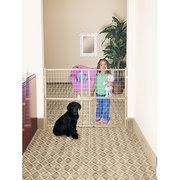

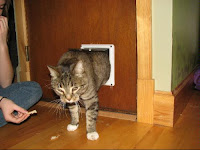
2. Install a cat door into an interior door.
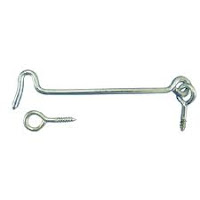
3. Use a hook and eye assembly to keep a door ajar just a few inches, no more, no less.
4. Use a covered litter box, or a large rubber or plastic box to keep the opening within just a few inches of the wall, or to provide a top entrance to the litter box.
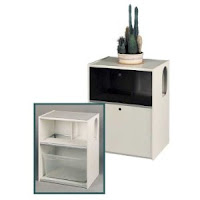
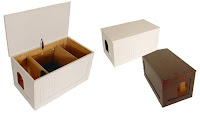
5. Consider a litter box containment system. This is the most expensive option, but it could also be the most effective. Litter box containment systems are dog-proof boxes, usually wooden, with two levels: one at the top where the cat enters and one at the bottom where a litter tray is contained.
Clumping cat litter is designed to absorb fluid (cat urine) and harden into a solid clump for easy clean-up of waste. If large amounts of cat litter are consumed by a dog, the litter absorbs fluid from the stomach and intestines and can create a solid obstruction to normal flow through the gastrointestinal tract. Needless to say, this requires a surgical solution. Additionally, snacking from the cat litter box can result in transmission of intestinal parasites from cat to dog, including roundworms, hookworms, tapeworms and Giardia.
The best way to prevent raiding of the cat litter box is to prevent the dog from having access to it. Below are some suggestions for just that:
1. Use a baby gate across a doorway.


2. Install a cat door into an interior door.

3. Use a hook and eye assembly to keep a door ajar just a few inches, no more, no less.

4. Use a covered litter box, or a large rubber or plastic box to keep the opening within just a few inches of the wall, or to provide a top entrance to the litter box.
5. Consider a litter box containment system. This is the most expensive option, but it could also be the most effective. Litter box containment systems are dog-proof boxes, usually wooden, with two levels: one at the top where the cat enters and one at the bottom where a litter tray is contained.


Tuesday, November 9, 2010
Coprophagia
Dear Dr. Lee,
My 4 year old yellow lab, Kenny, is a beloved family member, but he does have one annoying vice. He eats his own stool! He especially likes it when it is frozen, and sometimes brings his "snack" into the house. This is beyond disgusting - what can I do about this?
Ken's Fans in Bridgeport
Dear Ken's Fans,
Coprophagia, the oral consumption of feces, is a normal canine behavior that is not very acceptable by human standards. Coprophagia is not an indicator that a dog is being fed a substandard diet or has digestive problems. It is thought that this behavior was one inherited from wild canine ancestors who did not always have access to regular nutrition, and needed to scavenge to stay alive.
The best way to prevent coprophagy is to pick up stool in the dog's yard as soon as it is deposited. This will deny the dog the opportunity to eat his own, or his housemates feces. If out walking in public areas, keep your dog on a shorter leash so that you can prevent his contact with the feces of other dogs whose owners do not pick up after them (shame on them!). Another technique is to place a muzzle on the dog before going outside to inhibit stool consumption.
Other commonly suggested methods include using a powdered food additive (Forbid), mixing meat tenderizer, cottage cheese or pineapple with food, or lacing already deposited stool with cayenne pepper or hot sauce. While these additives do make the stool distasteful, the most persistantly coprophagic dogs will be able to smell which stools are "doctored" and which are not, thus know which piles are less distasteful to consume.
If your dog consumes the stool of other animals, monthly broad-spectrum deworming becomes especially important for the health of the dog, and to keep him from shedding intestinal parasite eggs that could potentially infect the humans he shares his house with. This can be acheived through monthly, year-round administration of heartworm preventatives such as Sentinel, Interceptor, Heartguard Plus, or Revolution.
Sincerely,
Dr. Lee
My 4 year old yellow lab, Kenny, is a beloved family member, but he does have one annoying vice. He eats his own stool! He especially likes it when it is frozen, and sometimes brings his "snack" into the house. This is beyond disgusting - what can I do about this?
Ken's Fans in Bridgeport
Dear Ken's Fans,
Coprophagia, the oral consumption of feces, is a normal canine behavior that is not very acceptable by human standards. Coprophagia is not an indicator that a dog is being fed a substandard diet or has digestive problems. It is thought that this behavior was one inherited from wild canine ancestors who did not always have access to regular nutrition, and needed to scavenge to stay alive.
The best way to prevent coprophagy is to pick up stool in the dog's yard as soon as it is deposited. This will deny the dog the opportunity to eat his own, or his housemates feces. If out walking in public areas, keep your dog on a shorter leash so that you can prevent his contact with the feces of other dogs whose owners do not pick up after them (shame on them!). Another technique is to place a muzzle on the dog before going outside to inhibit stool consumption.
Other commonly suggested methods include using a powdered food additive (Forbid), mixing meat tenderizer, cottage cheese or pineapple with food, or lacing already deposited stool with cayenne pepper or hot sauce. While these additives do make the stool distasteful, the most persistantly coprophagic dogs will be able to smell which stools are "doctored" and which are not, thus know which piles are less distasteful to consume.
If your dog consumes the stool of other animals, monthly broad-spectrum deworming becomes especially important for the health of the dog, and to keep him from shedding intestinal parasite eggs that could potentially infect the humans he shares his house with. This can be acheived through monthly, year-round administration of heartworm preventatives such as Sentinel, Interceptor, Heartguard Plus, or Revolution.
Sincerely,
Dr. Lee
Update: Destructive Scratching solution
This is a follow up to the post "Destructive Scratching" that was posted in June 2009.
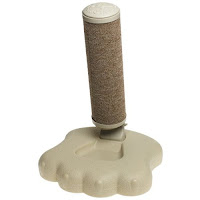
I have recently come upon a new interactive device meant for cats. It is called Pavlov's Cat Scratch Feeder, and it consists of a scratching post that holds dry treats or cat food. When the cat uses the scratching post, some food is automatically dispensed, and the cat is rewarded for scratching in an appropriate place! Wow!
I have recently come upon a new interactive device meant for cats. It is called Pavlov's Cat Scratch Feeder, and it consists of a scratching post that holds dry treats or cat food. When the cat uses the scratching post, some food is automatically dispensed, and the cat is rewarded for scratching in an appropriate place! Wow!

Tuesday, June 8, 2010
Reducing the stress of cat transport
Since Syracuse is a college town, I have had several college students and professionals come in for health examinations because they are taking a cat home for the summer, or they are moving to another part of the country. One of the most frequently asked questions is "can I sedate my cat for travel?"
Sedation of felines for transportation is not particularly desirable, and some sedatives can cause blood pressure changes that can be dangerous during transport. A cat owner who has advanced notice of travel plans can help the cat travel without the use of sedatives, and thus more safely by acclimating their cat to the carrier and to traveling (at least in a car). Here are some tips that were published in AAHA's Trends magazine this past March:
1. Socialize cats and kittens to the carrier and to traveling.
- Keep the carrier out and accessible in the home.
- Make and maintain a positive association with the carrier by making it a comfortable resting, feeding, or play location.
- Take the cat in the carrier on periodic car rides with positive experiences (i.e., not just to the veterinary office).
2. Withhold food prior to travel to help prevent motion sickness. It may also make the cat more interested in treats at the end destination.
3. Use Feliway on and in the carrier on a routine basis and just prior to transportation. Feliway is available from veterinarians, and is also marketed at major pet stores as Comfort Zone for Cats. Placing a worn item of clothing in the carrier from a favorite person can also help to make the carrier more welcoming.
4. Provide cover or hiding options in or over the carrier during transportation. A blanket or towel draped over the carrier can work very well.
If the cat owner can take the time and make the effort to acclimate the cat to travel, it can be a better experience for all.
Sedation of felines for transportation is not particularly desirable, and some sedatives can cause blood pressure changes that can be dangerous during transport. A cat owner who has advanced notice of travel plans can help the cat travel without the use of sedatives, and thus more safely by acclimating their cat to the carrier and to traveling (at least in a car). Here are some tips that were published in AAHA's Trends magazine this past March:
1. Socialize cats and kittens to the carrier and to traveling.
- Keep the carrier out and accessible in the home.
- Make and maintain a positive association with the carrier by making it a comfortable resting, feeding, or play location.
- Take the cat in the carrier on periodic car rides with positive experiences (i.e., not just to the veterinary office).
2. Withhold food prior to travel to help prevent motion sickness. It may also make the cat more interested in treats at the end destination.
3. Use Feliway on and in the carrier on a routine basis and just prior to transportation. Feliway is available from veterinarians, and is also marketed at major pet stores as Comfort Zone for Cats. Placing a worn item of clothing in the carrier from a favorite person can also help to make the carrier more welcoming.
4. Provide cover or hiding options in or over the carrier during transportation. A blanket or towel draped over the carrier can work very well.
If the cat owner can take the time and make the effort to acclimate the cat to travel, it can be a better experience for all.
Monday, July 27, 2009
Body Parts are not Toys
[This was originally posted to the Fairmount Animal Hospital website on 22 December 2008.]
Dear Dr. Lee,
My 5 month-old Bearded Collie, Lillith, keeps grabbing my hand with her teeth. She does not bite down, but it is annoying. She does it when we are playing, and even if I’m just taking her for a walk, she’ll leap up and grab it. Thank goodness she does not have many puppy teeth left. An even bigger problem is that she is now doing this with my guests. I am embarrassed and a little afraid someone might sue me, thinking she bit someone aggressively. What can I do?
Sincerely,
Mouthed in Manlius
Dear Mouthed,
Mouthing is a common behavior exhibited by puppies, particularly those who are exploring their world through their mouths or teething. It is, however, not an acceptable behavior when it is applied to any human body part. Potential consequences can range from mere annoyance, to fear, anger, a potential lawsuit and loss of homeowner’s insurance.
When a new dog enters your house, you should immediately make it a rule that no canine teeth touch human skin. Any touch of teeth to skin can be construed as a bite. Most dogs mouth humans because they want to either initiate play or escalate the level of play. To teach the new rule, consider the following recommendations:
• Do not offer your body parts for your dog to mouth, even if it is just to keep him out of trouble. If you have a puppy who is going through the oral stage, offer an acceptable alternative for him to chew (a toy).
• If you see your dog leaping at you to grab your hand, tuck your hands under your armpits and withdraw attention until your dog can ask for your attention in a more acceptable manner.
• If your dog sneaks up on you and puts his teeth on you, yip (as if you were a hurt puppy), act like the teeth burned you, and shun the dog for 30 seconds (no looking, speaking to, or touching). In this manner, you let the dog know that he hurt you, and you fail to give him what he really wanted (start of or more intense play).
• If your dog chooses to interact with you with a toy instead of mouthing you, be sure to reward that – it is a behavior we DO want.
Sincerely,
Dr. Lee
Dear Dr. Lee,
My 5 month-old Bearded Collie, Lillith, keeps grabbing my hand with her teeth. She does not bite down, but it is annoying. She does it when we are playing, and even if I’m just taking her for a walk, she’ll leap up and grab it. Thank goodness she does not have many puppy teeth left. An even bigger problem is that she is now doing this with my guests. I am embarrassed and a little afraid someone might sue me, thinking she bit someone aggressively. What can I do?
Sincerely,
Mouthed in Manlius
Dear Mouthed,
Mouthing is a common behavior exhibited by puppies, particularly those who are exploring their world through their mouths or teething. It is, however, not an acceptable behavior when it is applied to any human body part. Potential consequences can range from mere annoyance, to fear, anger, a potential lawsuit and loss of homeowner’s insurance.
When a new dog enters your house, you should immediately make it a rule that no canine teeth touch human skin. Any touch of teeth to skin can be construed as a bite. Most dogs mouth humans because they want to either initiate play or escalate the level of play. To teach the new rule, consider the following recommendations:
• Do not offer your body parts for your dog to mouth, even if it is just to keep him out of trouble. If you have a puppy who is going through the oral stage, offer an acceptable alternative for him to chew (a toy).
• If you see your dog leaping at you to grab your hand, tuck your hands under your armpits and withdraw attention until your dog can ask for your attention in a more acceptable manner.
• If your dog sneaks up on you and puts his teeth on you, yip (as if you were a hurt puppy), act like the teeth burned you, and shun the dog for 30 seconds (no looking, speaking to, or touching). In this manner, you let the dog know that he hurt you, and you fail to give him what he really wanted (start of or more intense play).
• If your dog chooses to interact with you with a toy instead of mouthing you, be sure to reward that – it is a behavior we DO want.
Sincerely,
Dr. Lee
Desensitization to the Veterinary Exam
[This was originally posted to the Fairmount Animal Hospital website on 15 December 2008.]
Dear Dr. Lee,
My Siberian Husky almost bit her veterinarian last week when we went in for a routine physical examination. He was trying to feel her abdomen, and she turned around an tried to nip him. I was terribly embarrassed, because while this is the first time she tried to bite, she has always been touchy about her belly, even as a puppy (in the past, she’s bared her teeth and growled). We eventually used a muzzle and the veterinarian was able to determine there was nothing obviously wrong with her. Other than getting her used to a muzzle, what can I do to help this situation?
Concerned in Cato
Dear Concerned,
I certainly appreciate your dedication to your dog’s well being. The physical examination is the foundation of good medical care for any pet, and in order for that to happen, the pet needs to be at least somewhat cooperative.
Desensitization to the veterinary exam should be done with all puppies and kittens, although there is no reason why you cannot do this with an adult dog as well.
Starting with her head, lift up her lips and inspect her teeth. Be sure to pull her lips back to look at her molars, too. Open her mouth and look at the roof of her mouth and her tongue. Peer into her ears, and massage them, and briefly insert a finger into the ear canal if it will fit. Massage her all over, including her face, neck, back, sides, underneath, upper limbs, lower limbs, tail and feet. Lift the tail, pick up a foot at a time, pinch the toenails. If she is sensitive in any of these areas, back off on the intensity of the touch, and reward her positively (verbal praise, small food treat), for allowing you to slowly increase the pressure and duration of touch in those sensitive areas.
If your dog flops over onto her back while you touch her, that is fine in the beginning, but consider that most of the veterinary exam is done with the dog in an upright position, and you may eventually want to train for that, as well.
Ask the veterinary office if it would be permissible to bring your dog in for a “happy visit” in which she walks into the hospital, walks on the scale, and interacts with some of the staff in a very positive manner. These “happy visits” involve no needles or other painful stimuli, and can teach your dog to be relaxed even in the waiting room.
Sincerely,
Dr. Lee
Dear Dr. Lee,
My Siberian Husky almost bit her veterinarian last week when we went in for a routine physical examination. He was trying to feel her abdomen, and she turned around an tried to nip him. I was terribly embarrassed, because while this is the first time she tried to bite, she has always been touchy about her belly, even as a puppy (in the past, she’s bared her teeth and growled). We eventually used a muzzle and the veterinarian was able to determine there was nothing obviously wrong with her. Other than getting her used to a muzzle, what can I do to help this situation?
Concerned in Cato
Dear Concerned,
I certainly appreciate your dedication to your dog’s well being. The physical examination is the foundation of good medical care for any pet, and in order for that to happen, the pet needs to be at least somewhat cooperative.
Desensitization to the veterinary exam should be done with all puppies and kittens, although there is no reason why you cannot do this with an adult dog as well.
Starting with her head, lift up her lips and inspect her teeth. Be sure to pull her lips back to look at her molars, too. Open her mouth and look at the roof of her mouth and her tongue. Peer into her ears, and massage them, and briefly insert a finger into the ear canal if it will fit. Massage her all over, including her face, neck, back, sides, underneath, upper limbs, lower limbs, tail and feet. Lift the tail, pick up a foot at a time, pinch the toenails. If she is sensitive in any of these areas, back off on the intensity of the touch, and reward her positively (verbal praise, small food treat), for allowing you to slowly increase the pressure and duration of touch in those sensitive areas.
If your dog flops over onto her back while you touch her, that is fine in the beginning, but consider that most of the veterinary exam is done with the dog in an upright position, and you may eventually want to train for that, as well.
Ask the veterinary office if it would be permissible to bring your dog in for a “happy visit” in which she walks into the hospital, walks on the scale, and interacts with some of the staff in a very positive manner. These “happy visits” involve no needles or other painful stimuli, and can teach your dog to be relaxed even in the waiting room.
Sincerely,
Dr. Lee
Boarding anxiety
[This was originally posted to the Fairmount Animal Hospital website on 8 December 2008.]
Dear Dr. Lee,
When my 2 dogs, 8 and 6 years old, went to the kennel, they always stayed in the same crate. My 8 year old never minded it, but my 6 year-old was extremely nervous and sometimes wouldn't eat for a couple of days. Two weeks ago, when they were at the kennel, my 8 year-old became ill and had to be euthanized. My question is, we are going away in three weeks and I don't know if my dog will be traumatized going back to the same kennel without my other dog. He never saw the dog after they euthanized her, so the last scent he remembers is her fear. Would it be better to switch kennels, even though the staff know and love him? Or will he be more traumatized going to a new place with new staff and a new routine? Do you feel he will remember everything that happened at the kennel? I'd appreciate any suggestions you may have. Thanks you so much!
~ Distraught in Syracuse
Dear Distraught,
First, please accept my heartfelt condolences for your tragic loss. This must have been awful for everyone, including you, your six year-old dog, and the kennel personnel. Even if your dog does not remember the details of his last kennel stay, he will no doubt miss your other dog, as she was always there when they were kenneled.
You have multiple options for your dog as far as boarding when you go out of town. It is not unusual for dogs to be nervous when then are kenneled, and this can result in behaviors such as anorexia. If you feel the personnel at the boarding kennel you like and know will treat him well, you can certainly do a test run by boarding him for the day, and seeing how he does. Have them feed him his breakfast and see if he will eat for them, or take treats from them, or both. You may also opt to do this at a new kennel and compare his behaviors at each.
Another option is to hire a house sitter who would be willing to care for your dog as well. This does offer more personalized attention and a familiar and comfortable environment for your dog.
If your dog does not do well in either situation because he is grieving, speak with your veterinarian about the possibility of using a short (3-6 months) course of an anti-anxiety medication to help, and try to get him involved in family activities and exercise as much as possible.
Sincerely,
Dr. Lee
Dear Dr. Lee,
When my 2 dogs, 8 and 6 years old, went to the kennel, they always stayed in the same crate. My 8 year old never minded it, but my 6 year-old was extremely nervous and sometimes wouldn't eat for a couple of days. Two weeks ago, when they were at the kennel, my 8 year-old became ill and had to be euthanized. My question is, we are going away in three weeks and I don't know if my dog will be traumatized going back to the same kennel without my other dog. He never saw the dog after they euthanized her, so the last scent he remembers is her fear. Would it be better to switch kennels, even though the staff know and love him? Or will he be more traumatized going to a new place with new staff and a new routine? Do you feel he will remember everything that happened at the kennel? I'd appreciate any suggestions you may have. Thanks you so much!
~ Distraught in Syracuse
Dear Distraught,
First, please accept my heartfelt condolences for your tragic loss. This must have been awful for everyone, including you, your six year-old dog, and the kennel personnel. Even if your dog does not remember the details of his last kennel stay, he will no doubt miss your other dog, as she was always there when they were kenneled.
You have multiple options for your dog as far as boarding when you go out of town. It is not unusual for dogs to be nervous when then are kenneled, and this can result in behaviors such as anorexia. If you feel the personnel at the boarding kennel you like and know will treat him well, you can certainly do a test run by boarding him for the day, and seeing how he does. Have them feed him his breakfast and see if he will eat for them, or take treats from them, or both. You may also opt to do this at a new kennel and compare his behaviors at each.
Another option is to hire a house sitter who would be willing to care for your dog as well. This does offer more personalized attention and a familiar and comfortable environment for your dog.
If your dog does not do well in either situation because he is grieving, speak with your veterinarian about the possibility of using a short (3-6 months) course of an anti-anxiety medication to help, and try to get him involved in family activities and exercise as much as possible.
Sincerely,
Dr. Lee
Cat Toy Preference
[This was originally posted to the Fairmount Animal Hospital website on 1 December 2008.]
Dear Dr. Lee,
My sister’s cat loves fuzzy mice toys. When I got my new cat from the animal shelter, I bought a half dozen fuzzy mice for him, but he ignores them. Is there something wrong with him?
Puzzled in Palermo
Dear Puzzled,
Cats can have distinct prey preferences, even if they have been indoors all their lives, and this may influence his choice of play toys. Prey preference can fall into the general categories of “bird,” “mouse,” and “bug.”
“Bird” toys have feathers attached to them. Some of them fly through the air (fishing pole type toys). Peacock feathers can be the ultimate “bird” toy. Toys that make chirping sounds also fall into this category.
“Mouse” type toys can be covered with fur. Stuffed animals and balls also fall into this category. These toys move on the ground instead of flying through the air.
“Bug” toys are small and move rapidly. Examples include laser pointers, a string with a knot tied at the end, or a kibble thrown across the floor.
In order to figure out your cat’s toy preference, determine what kind of prey he prefers. If your cat spends time looking out a window, see if you can figure out what captures his attention the most. Is it the bird that lands on the branch nearby, or the bug that flies near the window pane, or the chipmunk in the garden? You can also test your cats preferences by providing toys in different categories sequentially or at the same time, and seeing what your cat chooses.
Sincerely,
Dr. Lee
Dear Dr. Lee,
My sister’s cat loves fuzzy mice toys. When I got my new cat from the animal shelter, I bought a half dozen fuzzy mice for him, but he ignores them. Is there something wrong with him?
Puzzled in Palermo
Dear Puzzled,
Cats can have distinct prey preferences, even if they have been indoors all their lives, and this may influence his choice of play toys. Prey preference can fall into the general categories of “bird,” “mouse,” and “bug.”
“Bird” toys have feathers attached to them. Some of them fly through the air (fishing pole type toys). Peacock feathers can be the ultimate “bird” toy. Toys that make chirping sounds also fall into this category.
“Mouse” type toys can be covered with fur. Stuffed animals and balls also fall into this category. These toys move on the ground instead of flying through the air.
“Bug” toys are small and move rapidly. Examples include laser pointers, a string with a knot tied at the end, or a kibble thrown across the floor.
In order to figure out your cat’s toy preference, determine what kind of prey he prefers. If your cat spends time looking out a window, see if you can figure out what captures his attention the most. Is it the bird that lands on the branch nearby, or the bug that flies near the window pane, or the chipmunk in the garden? You can also test your cats preferences by providing toys in different categories sequentially or at the same time, and seeing what your cat chooses.
Sincerely,
Dr. Lee
Interactive Feline Play
[This was originally posted to the Fairmount Animal Hospital web site on 24 November 2008.]
Dear Dr. Lee,
I’ve been told by my veterinarian that my cat is too heavy. Other than limiting calories, is there anything else I can do to keep my cat fit? How do you get a cat to do jumping jacks?
Chubbs in Canastota
Dear Chubbs,
I have yet to see a cat do jumping jacks, but there are ways to increase your cat’s activity level, which can result not only in weight control, but enhance the bond with your cat. Planned sessions of interactive play can also result in a cat willing to rest when you do (and thus less inclined to bother you while you’re sleeping), and may decrease play aggression because your play will be in a controlled manner.
Here are some suggestions for play with your cat:
• Fetch – If your cat does not fetch yet, tie a string to his favorite toy, toss the toy, then reel it back in. Eventually, your cat may start bringing the toy back to you himself because he gets rewarded by another toss of the toy.
• Drag a string or a shoelace around the house. To increase interest, you can tie a knot or attach a folded paper fan. You can drag the string up and down areas that your cat is allowed to climb to increase the intensity of his “work out.”
• Ball – If your cat does not know how to play with one, you may need to help him by pushing it yourself first. This is particularly fun on hard surfaces, like hardwood floors or the bathtub. There are treat balls that you can load with kibble or treats that reward the cat for playing with it – as the cat plays with it, food falls out.
• The recall game – with a friend or family member, have your cat run between the two of you and reward with a small food treat each time the cat runs to you.
• Toss – throw a piece of kibble or a treat down a long hallway for your food-motivated cat.
• Hang a toy from a doorknob or the top of the door frame. Jiggle it to make it more interesting.
• Container game – Use an empty paper bag or cardboard box. Cats are naturally curious about these spaces. When he goes in, scratch the outside of the container with your finger and your cat may try to catch your finger through the container wall.
• Movement – make any toy your cat likes more interesting by making it move.
• Laser pointer – many cats will chase the beam for hours. Do not direct the beam into the eyes of people or animals. Do not use this method of play with dogs, as they can develop obsessive compulsive disorder.
• Hide and seek – pretend to hide. As your cat approaches your hiding spot, “reveal” yourself and pet your cat and tell him how brilliant he is.
• Toy rotation – do not leave all your cats toys out at the same time. Hide them and rotate through them – it adds an aspect of novelty, even if it is a toy he has played with before.
Some additional hints: Do not reward bad behavior by playing with your cat – start a play session when your cat is calm. Do not use body parts as toys (see Play Aggression article). Set aside specific times of day for the play sessions so that your cat knows when to anticipate his fun time.
Sincerely,
Dr. Lee
P.S. Next week, how to choose toys for your cat.
Dear Dr. Lee,
I’ve been told by my veterinarian that my cat is too heavy. Other than limiting calories, is there anything else I can do to keep my cat fit? How do you get a cat to do jumping jacks?
Chubbs in Canastota
Dear Chubbs,
I have yet to see a cat do jumping jacks, but there are ways to increase your cat’s activity level, which can result not only in weight control, but enhance the bond with your cat. Planned sessions of interactive play can also result in a cat willing to rest when you do (and thus less inclined to bother you while you’re sleeping), and may decrease play aggression because your play will be in a controlled manner.
Here are some suggestions for play with your cat:
• Fetch – If your cat does not fetch yet, tie a string to his favorite toy, toss the toy, then reel it back in. Eventually, your cat may start bringing the toy back to you himself because he gets rewarded by another toss of the toy.
• Drag a string or a shoelace around the house. To increase interest, you can tie a knot or attach a folded paper fan. You can drag the string up and down areas that your cat is allowed to climb to increase the intensity of his “work out.”
• Ball – If your cat does not know how to play with one, you may need to help him by pushing it yourself first. This is particularly fun on hard surfaces, like hardwood floors or the bathtub. There are treat balls that you can load with kibble or treats that reward the cat for playing with it – as the cat plays with it, food falls out.
• The recall game – with a friend or family member, have your cat run between the two of you and reward with a small food treat each time the cat runs to you.
• Toss – throw a piece of kibble or a treat down a long hallway for your food-motivated cat.
• Hang a toy from a doorknob or the top of the door frame. Jiggle it to make it more interesting.
• Container game – Use an empty paper bag or cardboard box. Cats are naturally curious about these spaces. When he goes in, scratch the outside of the container with your finger and your cat may try to catch your finger through the container wall.
• Movement – make any toy your cat likes more interesting by making it move.
• Laser pointer – many cats will chase the beam for hours. Do not direct the beam into the eyes of people or animals. Do not use this method of play with dogs, as they can develop obsessive compulsive disorder.
• Hide and seek – pretend to hide. As your cat approaches your hiding spot, “reveal” yourself and pet your cat and tell him how brilliant he is.
• Toy rotation – do not leave all your cats toys out at the same time. Hide them and rotate through them – it adds an aspect of novelty, even if it is a toy he has played with before.
Some additional hints: Do not reward bad behavior by playing with your cat – start a play session when your cat is calm. Do not use body parts as toys (see Play Aggression article). Set aside specific times of day for the play sessions so that your cat knows when to anticipate his fun time.
Sincerely,
Dr. Lee
P.S. Next week, how to choose toys for your cat.
Cats on Counters
[This was originally posted to Fairmount Animal Hospital's website on 17 November 2008.]
Dear Dr. Lee,
I absolutely adore my kitten, Max. My mother is having fits because Max jumps up on the kitchen counters to investigate. Mom says that is where she prepares meals, and cats should not be up there. How can I teach Max not to jump up on the counter?
Smitten to the Max in Dewitt
Dear Smitten,
Kittens are normally energetic and inquisitive creatures. It is not surprising Max has discovered that the kitchen counter is an interesting place to be. Thus it is important to keep the counter free of food and potential playthings (i.e., twist ties, plastic bags, etc.) so that he does not have the opportunity to self-reward himself for being up there.
Some cats can be negatively reinforced from certain behaviors by a squirt from a water gun. However, most cats learn to avoid the behavior when the squirt gun is present, and when it is not, they feel at liberty to pursue the behavior because there is no consequence.
There ares battery operated device called Ssscat! and Spray Sentry that can help to reinforce boundaries in a non-painful way, even if you are not present. When the motion sensor is tripped, the device emits a jet of compressed air (hence the name), which startles the cat.
Sincerely,
Dr. Lee
Dear Dr. Lee,
I absolutely adore my kitten, Max. My mother is having fits because Max jumps up on the kitchen counters to investigate. Mom says that is where she prepares meals, and cats should not be up there. How can I teach Max not to jump up on the counter?
Smitten to the Max in Dewitt
Dear Smitten,
Kittens are normally energetic and inquisitive creatures. It is not surprising Max has discovered that the kitchen counter is an interesting place to be. Thus it is important to keep the counter free of food and potential playthings (i.e., twist ties, plastic bags, etc.) so that he does not have the opportunity to self-reward himself for being up there.
Some cats can be negatively reinforced from certain behaviors by a squirt from a water gun. However, most cats learn to avoid the behavior when the squirt gun is present, and when it is not, they feel at liberty to pursue the behavior because there is no consequence.
There ares battery operated device called Ssscat! and Spray Sentry that can help to reinforce boundaries in a non-painful way, even if you are not present. When the motion sensor is tripped, the device emits a jet of compressed air (hence the name), which startles the cat.
Sincerely,
Dr. Lee
Muzzles
[This was originally posted to the Fairmount Animal Hospital website on 10 November 2008.]
Dear Dr. Lee,
My German Shepherd Dog is terrified when he goes to the veterinary office or to the groomer’s for a bath. I am afraid he is going to bite someone. At home he is a sweetheart. Any suggestions?
Nervous in Camillus
Dear Nervous,
The veterinary office and the grooming salon can be nerve wracking places for your dog because he may be manipulated in ways in which he is not altogether comfortable. One of the best things that you can do is bring your dog to those places for “happy visits” in which he goes into the building, maybe stands on the scale and gets a cookie from a receptionist or assistant, and then leaves, without being poked or prodded. This will help to reduce the amount of anxiety associated with the physical location.
The muzzle is a wonderful tool that can help to prevent a bite by an animal that is scared, painful or aggressive. Typical muzzles that can be purchased include a nylon fabric type and a basket type. The basket muzzle has the advantage in that the dog can pant easily. Also, they can learn to dunk the whole muzzle in a bowl of water to drink, and treats can easily be delivered through between the wires.

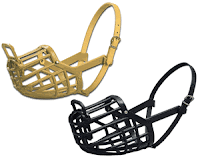
You can train your dog to accept a muzzle easily. This will allow you to put the muzzle on in situations in which he might need to have one on with minimal fuss. With the basket muzzle, start with a hungry dog. Place a delectable treat into the open basket and offer it to your dog. He should readily stick his nose into the basket to retrieve the treat. Repeat multiple times until you are sure he is comfortable with this. When he reaches that point, you may start playing with the strap while he is eating out of the basket. This will desensitize him to having the strap manipulated. Eventually, you should be able to buckle the strap behind the ears, at which point, you can continue to give your dog treats through the muzzle wires. This procedure can also be adapted to the nylon fabric muzzle; start with a treat delivered between your fingers placed backwards through the nose opening so that you can entice your dog to move his face forward into the muzzle. Soft dog foods and peanut butter work well for rewarding the wearing of the nylon muzzle. Have your dog wear the muzzle around the house at random times so that the wearing of the muzzle is not always associated with a perceived unpleasant experience.
In case of an emergency, you can make a muzzle out of a long strip of fabric, a shoelace, or panty hose. Place the middle of the tie underneath the dog’s chin. Tie a half hitch knot on top of the muzzle. Bring the ends of the ties underneath the dog’s chin and make an “X” so that the tie ends switch sides. Secure the ties behind the dog’s ears with a knot such as one you would use to tie your shoe.
If your dog can accept a muzzle, he will be able to be examined and treated or groomed more quickly, and with minimal risk to the handler, reducing the stress of the visit for all.
Sincerely,
Dr. Lee
Dear Dr. Lee,
My German Shepherd Dog is terrified when he goes to the veterinary office or to the groomer’s for a bath. I am afraid he is going to bite someone. At home he is a sweetheart. Any suggestions?
Nervous in Camillus
Dear Nervous,
The veterinary office and the grooming salon can be nerve wracking places for your dog because he may be manipulated in ways in which he is not altogether comfortable. One of the best things that you can do is bring your dog to those places for “happy visits” in which he goes into the building, maybe stands on the scale and gets a cookie from a receptionist or assistant, and then leaves, without being poked or prodded. This will help to reduce the amount of anxiety associated with the physical location.
The muzzle is a wonderful tool that can help to prevent a bite by an animal that is scared, painful or aggressive. Typical muzzles that can be purchased include a nylon fabric type and a basket type. The basket muzzle has the advantage in that the dog can pant easily. Also, they can learn to dunk the whole muzzle in a bowl of water to drink, and treats can easily be delivered through between the wires.


You can train your dog to accept a muzzle easily. This will allow you to put the muzzle on in situations in which he might need to have one on with minimal fuss. With the basket muzzle, start with a hungry dog. Place a delectable treat into the open basket and offer it to your dog. He should readily stick his nose into the basket to retrieve the treat. Repeat multiple times until you are sure he is comfortable with this. When he reaches that point, you may start playing with the strap while he is eating out of the basket. This will desensitize him to having the strap manipulated. Eventually, you should be able to buckle the strap behind the ears, at which point, you can continue to give your dog treats through the muzzle wires. This procedure can also be adapted to the nylon fabric muzzle; start with a treat delivered between your fingers placed backwards through the nose opening so that you can entice your dog to move his face forward into the muzzle. Soft dog foods and peanut butter work well for rewarding the wearing of the nylon muzzle. Have your dog wear the muzzle around the house at random times so that the wearing of the muzzle is not always associated with a perceived unpleasant experience.
In case of an emergency, you can make a muzzle out of a long strip of fabric, a shoelace, or panty hose. Place the middle of the tie underneath the dog’s chin. Tie a half hitch knot on top of the muzzle. Bring the ends of the ties underneath the dog’s chin and make an “X” so that the tie ends switch sides. Secure the ties behind the dog’s ears with a knot such as one you would use to tie your shoe.
If your dog can accept a muzzle, he will be able to be examined and treated or groomed more quickly, and with minimal risk to the handler, reducing the stress of the visit for all.
Sincerely,
Dr. Lee
Monday, June 1, 2009
Feline Spraying
[This was originally posted to the Fairmount Animal Hospital website on 3 November 2008.]
Dear Dr. Lee
I love my cats (I have 9 of them!), but one of them is spraying urine around my house, and it stinks! What can I do? I’d like to try to keep them all indoor-only, especially since I live by a busy road.
Stinky in Solvay
Dear Stinky,
Feline urine spraying is a normal behavior in both male and female cats, yet is is quite undesirable when humans share a residence with their cats. Spraying is used as a way to mark territory. The main offenders tend to be intact male cats, so if your male cat has not been neutered yet, consider doing so as soon as possible.
Be certain that the problem is spraying versus housesoiling (not using the litter box). Spraying tends to be on vertical surfaces and involves a small amount of urine. If you are not sure, consult with your veterinarian, who may want to start with a medical workup of the problem. If a medical problem has been ruled out, consider what might be the primary cause of the spraying.
Feral cats can have surprisingly large territories. If you have multiple cats in your house, it may be that your spraying cat may be vying for more territory versus your other cats. Increased density of cats in the house can also increase stress amongst the cats, and the chance of one or more spraying in response goes up.
If you have stray cats that roam close to your house, and your cat can see them, spraying near windows and doors can occur as a “warning” to the strange cats that this territory is already occupied. Blocking access to windows can help with this. Also discourage stray cats from entering your property; do not feed them, and consider the use of aversives (www.cat-repellant.info).
Treat all the urine-sprayed surfaces with an enzymatic cleaner to remove the odor. Consider the use of Feliway (also marketed as Comfort Zone for cats), which is a synthetic feline facial pheromone analogue. Feliway can help to reduce overall stress in your cats, and is available in a pump spray and as an electronic plug-in diffuser. Do not mix the enzymatic cleaner with the Feliway because the enzymes will degrade the Feliway, too.
Consider reducing the number of cats in your household, or at least vow not to add any more. A behaviorist may be able to identify other sources of stress experienced by your cats, and suggest behavior modification exercises that can help to alleviate it.
Also consider use of anti-anxiety medication to help reduce your cat’s stress. Examples include amitriptylene, busprione, clomipramine and fluoxetine. None of these medications are labeled for use in cats, and use of one or more of them would be off-label, but I have found them to be effective. Your veterinarian may want to do baseline bloodwork before starting the medication and monitoring bloodwork while your cat is on the medication to ensure his continuing health.
Sincerely,
Dr. Lee
Dear Dr. Lee
I love my cats (I have 9 of them!), but one of them is spraying urine around my house, and it stinks! What can I do? I’d like to try to keep them all indoor-only, especially since I live by a busy road.
Stinky in Solvay
Dear Stinky,
Feline urine spraying is a normal behavior in both male and female cats, yet is is quite undesirable when humans share a residence with their cats. Spraying is used as a way to mark territory. The main offenders tend to be intact male cats, so if your male cat has not been neutered yet, consider doing so as soon as possible.
Be certain that the problem is spraying versus housesoiling (not using the litter box). Spraying tends to be on vertical surfaces and involves a small amount of urine. If you are not sure, consult with your veterinarian, who may want to start with a medical workup of the problem. If a medical problem has been ruled out, consider what might be the primary cause of the spraying.
Feral cats can have surprisingly large territories. If you have multiple cats in your house, it may be that your spraying cat may be vying for more territory versus your other cats. Increased density of cats in the house can also increase stress amongst the cats, and the chance of one or more spraying in response goes up.
If you have stray cats that roam close to your house, and your cat can see them, spraying near windows and doors can occur as a “warning” to the strange cats that this territory is already occupied. Blocking access to windows can help with this. Also discourage stray cats from entering your property; do not feed them, and consider the use of aversives (www.cat-repellant.info).
Treat all the urine-sprayed surfaces with an enzymatic cleaner to remove the odor. Consider the use of Feliway (also marketed as Comfort Zone for cats), which is a synthetic feline facial pheromone analogue. Feliway can help to reduce overall stress in your cats, and is available in a pump spray and as an electronic plug-in diffuser. Do not mix the enzymatic cleaner with the Feliway because the enzymes will degrade the Feliway, too.
Consider reducing the number of cats in your household, or at least vow not to add any more. A behaviorist may be able to identify other sources of stress experienced by your cats, and suggest behavior modification exercises that can help to alleviate it.
Also consider use of anti-anxiety medication to help reduce your cat’s stress. Examples include amitriptylene, busprione, clomipramine and fluoxetine. None of these medications are labeled for use in cats, and use of one or more of them would be off-label, but I have found them to be effective. Your veterinarian may want to do baseline bloodwork before starting the medication and monitoring bloodwork while your cat is on the medication to ensure his continuing health.
Sincerely,
Dr. Lee
Subscribe to:
Posts (Atom)